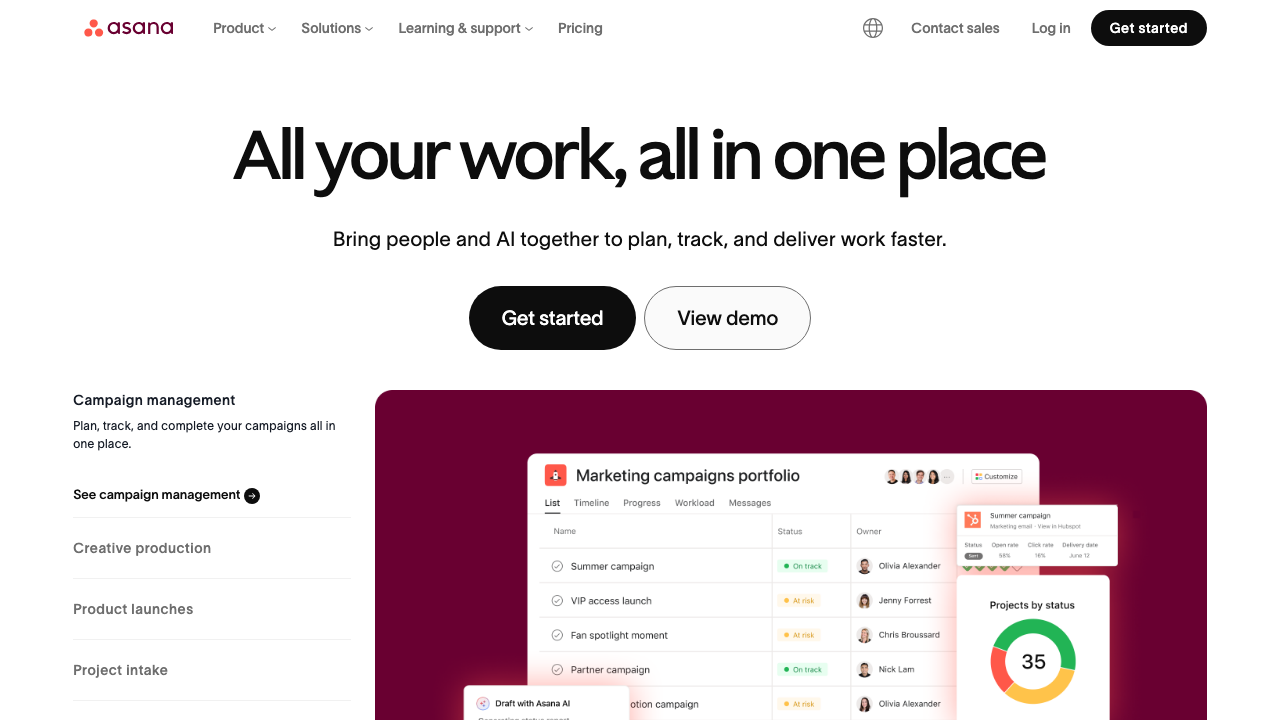
Asana’s goal-setting and project management is best-in-class for growing teams. The AI features in 2026 make it easier to keep projects on track without micromanaging your team. As small businesses increasingly rely on AI-powered tools to stay competitive, Asana positions itself as a practical solution for business workflows. In this review, we take a close look at what makes Asana worth your attention—and where it still has room to grow.
- Editorial Score: 85.0/10
- Best For: Goal tracking
- Free Plan: Yes
- Paid Plans From: Premium $10.99/user/mo · Business $24.99/user/mo
Key Features
Best goal + project alignment — Asana has built this capability into the core of its product, making it one of the more practical options for small businesses in the business space. Unlike some competitors that bolt on AI as an afterthought, this feature feels native and well-integrated into the overall workflow. For teams that depend on this functionality day-to-day, it represents a genuine competitive advantage.
Clean timeline views — Asana has built this capability into the core of its product, making it one of the more practical options for small businesses in the business space. Unlike some competitors that bolt on AI as an afterthought, this feature feels native and well-integrated into the overall workflow. For teams that depend on this functionality day-to-day, it represents a genuine competitive advantage.
Strong integrations — Asana has built this capability into the core of its product, making it one of the more practical options for small businesses in the business space. Unlike some competitors that bolt on AI as an afterthought, this feature feels native and well-integrated into the overall workflow. For teams that depend on this functionality day-to-day, it represents a genuine competitive advantage.
What We Like
Best goal + project alignment. This is one of the standout qualities of Asana. For small business owners who need results without a steep learning curve, this aspect of the platform delivers genuine value. It’s the kind of feature that keeps users coming back day after day.
Clean timeline views. This is one of the standout qualities of Asana. For small business owners who need results without a steep learning curve, this aspect of the platform delivers genuine value. It’s the kind of feature that keeps users coming back day after day.
Strong integrations. This is one of the standout qualities of Asana. For small business owners who need results without a steep learning curve, this aspect of the platform delivers genuine value. It’s the kind of feature that keeps users coming back day after day.
What Could Be Better
Gets expensive for larger teams. This is an area where Asana still has room to improve. While it may not be a dealbreaker for most small businesses, power users or teams with more complex needs might find this limitation frustrating. It’s something the team may address in future updates.
Free tier limits reporting. This is an area where Asana still has room to improve. While it may not be a dealbreaker for most small businesses, power users or teams with more complex needs might find this limitation frustrating. It’s something the team may address in future updates.
Who Is Asana Best For?
Asana is an excellent fit for small business owners, freelancers, and lean teams who need a dependable tool for Goal tracking.
If your business is in the early-to-mid growth stage and you’re looking to automate or improve your business processes without hiring additional staff, this platform is built with you in mind.
It is particularly well-suited for teams that prioritize ease of use over deep customization.
Entrepreneurs who want to get up and running quickly—without weeks of setup or IT support—will find Asana genuinely approachable.
On the other hand, large enterprises with highly specialized requirements may prefer a more configurable solution.
Pricing
Asana offers a free plan (Free up to 10 team members), making it accessible for businesses that want to explore the platform before committing.
For teams that need more capacity or advanced features, paid plans starting at Premium $10.99/user/mo · Business $24.99/user/mo.
Overall, the pricing structure is competitive for the business tools market, and the value you get—especially on entry-level tiers—stacks up well against comparable solutions.
Alternatives to Consider
If Asana doesn’t perfectly match your needs, the business tools space offers plenty of alternatives worth exploring.
Depending on your priorities, you might compare it against general business management suites, project management platforms, and CRM solutions.
Some alternatives may offer deeper integrations or more specialized feature sets, while others compete primarily on price.
We recommend browsing our full roundup to compare options side by side before making a final decision.
How Asana Compares
When stacked against Salesforce, Asana tends to win on simplicity and pricing.
Salesforce is a powerful platform, but its feature depth and cost structure make it a better fit for mid-market or enterprise teams.
For a small business that needs results quickly and doesn’t have a dedicated IT team, Asana is the more pragmatic starting point.
Compared to Monday.com, the picture is closer. Both target similar audiences, and the gap often comes down to specific workflow needs and personal preference.
Asana differentiates itself through its focus on Goal tracking, while Monday.com tends to appeal to teams that prioritise a broader feature set.
We recommend trying the free tier of each before committing — both offer enough to get a real feel for fit within a week.
Bottom Line
Asana is a outstanding choice for small businesses looking to enhance their business workflows with AI.
Earning an editorial score of 85.0/10, it stands out for its approachable design and practical feature set.
While it’s not without limitations, the overall package represents good value for the majority of small business users.
If your priorities align with what Asana does best, it’s well worth a closer look—and potentially a spot in your core toolset.
Frequently Asked Questions About Asana
Is Asana free?
Asana offers a free plan: Free up to 10 team members. Paid plans start from Premium $10.99/user/mo · Business $24.99/user/mo.
Who is Asana best for?
Asana is best for Goal tracking. Asana’s goal-setting and project management is best-in-class for growing teams. The AI features in 2026 make it easier t
What are the main advantages of Asana?
Key advantages include: Best goal + project alignment. Clean timeline views. Strong integrations.
What are the drawbacks of Asana?
Potential downsides: Gets expensive for larger teams. Free tier limits reporting.
How does Asana rate overall?
Asana scores 85/100 on AIToolKits.co’s editorial scale, making it a solid choice for most small businesses.